

Body Scanners Raise Privacy Concerns
By Micah McCoy, Communications Specialist
If you’ve flown out of the Albuquerque Sunport recently, you may have noticed an addition to the arsenal of gadgets the TSA uses to screen passengers. Standing among the array of metal detectors and x-ray machines is one of forty whole-body imaging (WBI) scanners in use in airports throughout the country. In the wake of the recent Christmas Day bombing attempt by Northwest Airlines passenger Umar Farouk Abdulmutallab, many politicians and pundits are loudly calling for these scanners to be put into widespread and routine use in all our major airports.
Advocates claim that routine body scans will reduce the chance of similar attacks occurring in the future. However, given our recent history of sacrificing civil liberties for what is often a false sense of security, let’s stop, catch our breath and think about this first. Specifically, is the non-targeted use of WBI scanners a real security solution worth compromising the privacy of millions?
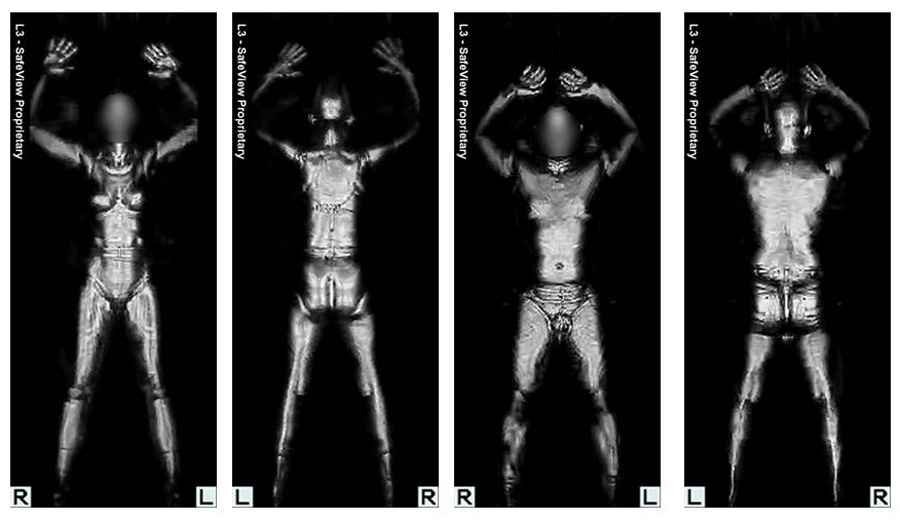
WBI scanners produce strikingly graphic 3D images of a person’s body under their clothes, rendering their use tantamount to a “digital strip search.” These scans reveal the most intimate contours of the body, including details such as mastectomy scars, colostomy bags and adult diapers. Knowing that a government employee will virtually see them naked is bound to cause many passengers significant mental and emotional discomfort. The ethics of these digital strip searches are even more complicated where children are concerned. Fearing the possible violation of child pornography laws, the UK has already prohibited the scanning of anyone under age 18 outright.
The TSA attempts to address these privacy concerns by viewing scans remotely via closed circuit monitors, blurring faces, and deleting images immediately after screening. These precautions are a step in the right direction, but these scanned body images may prove to be too great a temptation for some TSA workers. If the Internet has taught us anything, it’s that people have an insatiable interest in the anatomy of others. Some of these images are sure to leak.
When we allowed the NSA to wiretap our phones, they illegally eavesdropped on the most private details of our personal lives. Are we certain that the TSA is any more trustworthy with the most private details of our bodies?
Leaving aside the privacy concerns inherent in these devices, their effectiveness is far from certain. For example, WBI scanners are unable to detect any items concealed inside a person’s body. Do we really believe that anyone who is willing to blow themselves up will not also be willing to smuggle explosives in their body cavities? The scanners also prove unreliable in detecting items molded to the body or hidden in folds of skin. Recent British studies suggest that they are less effective in detecting low density materials such as plastic explosives, powders and liquids—precisely the type of material Abdulmutallab smuggled sewn into his underpants.
With this evidence in mind, we need to seriously question whether the $150,000+ required to purchase a WBI scanner could be put to better use elsewhere. Experience has shown us that diligent law enforcement and good intelligence work are still the most effective methods of foiling terrorist plots. At the time of his attempted attack, Abdulmutallab was on watch lists in both the USA and UK. With better communication and follow-up, he could have been stopped long before he passed through airport security.
We were all unnerved and frightened by the close call on Christmas Day, but we must acknowledge that decisions made in moments of fear and anxiety are rarely the best. Before we relinquish more of our civil liberties—ground that, once ceded, is extremely difficult to regain—we must be certain that the wholesale use of WBI scanners is both an effective tool in preventing terrorist attacks and compatible with our nation’s values. The scanners don’t measure up on either count.
This article appeared originally in the opinion section of The Albuquerque Journal on January 17, 2010.
Adrian S Part of the problem here is that you are ctonlanifg the right to be free from illegal search and seizure in a law enforcement custodial situation from that of a non-law enforcement and non-custodial situation.Let me use an example:If the cops wish to come to your house and search it, they have to have some idea what it is they are looking for and get a judge to sign off. If they see you do something on the street and arrest you, they have the right to do a safety sweep and search your person and anything within grabbing range, but they can’t toss your house because they arrested you in the doorway.The airport is fundamentally different, as is the patdown before you go into a municipal football stadium. Why? Because (a) it is a security screen, not seeking evidence of other general criminal conduct ; (b) you are not compelled to be there or to stay; (c) you control when or whether you are there in the first place; and (d) you can refuse if you wish . . . you just won’t be permitted to enter the gate or enter the stadium.You do NOT have a constitutional right under the Second Amendment or the Fourth Amendment to carry a gun wherever you want, or to avoid a safety sweep, any more than you have an unfettered First Amendment right to distribute written escape plans in a prison or yell Fire! in a crowded theater.Just as the screening works when you go to a court, everyone is fully aware of the rules when you want to fly. You have many options for travel: car, bus, train, boat. You do not have options on a police search, which is why the standards controlling the government’s actions are so strict.Reply
, it does seem that nation teafsnormrd overnight tho that is not so in this case. If there was an overnight change, it happened between Sept 11 and Sept 12.But the principle of the thing is to be considered. Because our principles are rooted and reflected in our rule of law. Thus why I labeled this a conundrum . Because what feels right in principles is actually firmly rooted in our laws and precedents already, and has been for decades. There is no expectation of privacy when you enter areas that are secured for one reason or another. And there is the expectation of safety from the nation’s citizens against terrorism.Is the trade off of liberty vs national security off the charts? Not when it comes to the particulars of scanners or screening. Certainly if the pat downs are abused, it is.. and therein lies the recourse for the victims. But overall is security screening unconstitutional? Not in the eyes of decades of precedents, and of the citizens’ acceptance of screening prior to this.Would it be acceptable, in the interest of profiling, to be required to disclose our choice of religion when purchasing an airline ticket? We already have to give our birthdates and gender, as of 2009 is that an improvement? I have to say no.. it’s just further erosion of our rights in the interest of national security, but would aid greatly in that unconstitutional type of profiling . even if, in principle, it makes sense.You also said:And someone else smarter than me pointed out, this is how a police-state works. They control the population’s ability to move about their own country. Why couldn’t the TSA be expanded and placed at state borders to stop all traffic and search cars? It’s all for safety. Two things stand out here to me. First, you object to TSA’s power in airport screening, but now want that same power on the border (with TSA or the border patrol)? Somewhat incongruous, don’t you think? Either that degree of searching/screening is okay, or it’s not. I suspect that were you one needing to cross the border with the same frequency that you fly, you might think differently. But when it comes to the 4th Amendment, it matters not whether the screening is on the border, or in the airports. It is, afterall, mostly innocents flying/crossing borders that are subject to the same conditions of scrutiny.The second thing is the control the population’s ability to move about in their own country bit. We already have that. Licenses required to drive the roadways, which we pay for in taxes. Drive into California and you are met with a checkpoint, asking you to produce any vegetables or fruit you are carrying. DUI check points have been deemed 4th Amendment constitutional via There are one way roads, speed limits, toll roads all are a control over moving about in the country.Again, it comes down to if that dividing line has crossed a legal line already delineated in the sand.@: You’re not STUPID. This machine scans through your clothing and takes NAKED PICTURES OF YOU.Forgive me if I’m not as enlightened as the columnist and think that common sense qualifies this as a violation of my person, my privacy, my rights as a human being and an American citizen. NO level of airport security gives them the right to grope your genitals or see you naked… and if the law says otherwise, the law is an ASS.rh, the photo that accompanies my post is one of the two image scans from the TSA approved scanners. Most are familiar with the opaque backscatter scanner image. The above is the millimeter wave scanner system, and produces something that looks more like The Terminator or Instant Recall . I suspect that were a scanned photo of you were erroneously released, even your mother wouldn’t know it was you. If she did, you have a case for a lawsuit. Also, there is no groping of genitals , as you say, unless you refuse to walk the thru the seconds taken to scan you. Your choice. Have at it. Me? I’ll take the scanner.That said, some are more sensitive to this stuff, and that’s okay. Me? I’ve seen the same in R rated movies, ballets, NFL football players in spandex, and art at museums or statutes in Italy (and they’remore explicit). It becomes even more bizarre when you think of where the American youth are the revealing photos they post on the internet/facebook, or send each other via cells. When you look at these photos in the context of other things, are they really that revealing? In which case you should be making complaints over the below the crack pants styles today’s young men wear, or the skin tight just above the crotch jeans the young girls wear these days. You’ll see more on the streets in any urban city (weather permitting) than you do in these images.As I said, what I wanted to was attempt to get another debate over this going that was more grounded, and not revolving around false assumptions of Constitutional rights or hyperbole over the random incidents that are tantamount to a miniscule percentage when you consider everyone that flies. I’m not in to inciting kids into a panic about walking thru a scanner for 5 seconds (and I’ve been thru both personally). And if we are to have a discussion about any options available for security vs liberty, it might be nice if it revolved around some legal realities. Certainly discussing non discriminatory profiling methods that are founded on the Israeli methods, but adapted for our volume, I’m all for it. But I’m certainly not interested in selectively deciding which of the Bill of Rights and Constitutional Amendments are worthy of evoking, and which are worth tossing over the side of the ship simultaneously.While it’s nice to vent just as everyone did for months over the ground zero mosque what does it accomplish by ratcheting up all the hyped versions of incidents? Nothing just as all the wringing of hands over Cordoba House accomplished nothing. You either want to moan and complain, or you want to find some solutions. That is what I’d rather engage in.Reply